Wine in the Time of Pestilence IV

There has been a lot of press chatter around the idea that we are drinking more in the Covid-19 crisis.  The Sydney Morning Herald reported that online sales for one retailer had jumped by 50-75%; Nielsen tracking figures for wine sales in the USA showed dramatic rises in wine sales in the two weeks following the start of lockdown in key states, then a dramatic fall, then two more weeks of increase (though less intense).  There has been an increase of wine sales in the USA of 29.4% since the ‘start’ of Covid-19 – just behind the increase in spirits sales but well ahead of beer on 19%; this has also seen a surge in sales of cabernet sauvignon – as if consumers want to go back to what is tried and tested.  Meanwhile in the UK I’ve heard through the grapevine, that for some UK retailers March was their best month ever.  What seems to be selling is their core range – so that consumers are indeed sticking with brands they know well and feel comfortable with, with sales of these wines almost one quarter up on normal.  That could include things like Rioja, Argentine malbec and pinot grigio.  The winners, it seems, are winning even more.

So, the sales figures seem to bear this out this general idea that everyone is drinking more wine, though the detail is much more complex than that.  As I’ve noted previously, the ease of buying wine in France isn’t mirrored in South Africa, for instance.  So how is our drinking behaviour changing?  By which I don’t just mean how much we drink, but how and what we drink – and why we may be drinking more.  Looking at my own drinking I felt it was changing, and anecdotally it appeared that others were changing theirs as well.

So, it occurred to me that it would be interesting to find out how some dedicated drinkers have been changing their relationship with alcohol during the spread of the virus.  To do this I chose my own colleagues in the Institute of Masters of Wine with a short survey on how they are drinking during the time of pestilence.  We asked both numeric questions and asked them to add comments about their drinking – and this is what transpired.  As this is a blog about ‘wine and culture’ I’m going to focus on the most interesting cultural findings.

I received completed surveys from 142 Masters of Wine, which is a good response rate and the sample was broadly representative of the Institute’s gender and geographic make up (65% male and 47% based in the UK).  The ‘typical’ respondent was aged about 56 and had been in confinement for just over 18 days at the point when they responded.  They pay on average just under 18€ per bottle when they buy wine, drinking about 5-6 days per week.

Forty-two percent said that their wine consumption had increased since the onset of Covid-19, while 15% said it had decreased, and for 43% it had not altered.  However, an examination of who is drinking more or less reveals some interesting and statistically significant results.  Those who are drinking less wine are disproportionately male (85%) rather than female – but those drinking more are proportionately more likely to be female.  The following quotation illustrates this:

I think anyone home-schooling kids whilst working from home during lockdown is definitely drinking more wine.

The same trend is even more marked for buying wine: women are more likely to be buying more wine than before Covid-19 by 60% to 40% for men. 

Interestingly, when we look at the country of residence of Masters of Wine drinking more or less there was no obvious difference between the regions of the world – except that none of the Australasian Masters of Wine claim to be drinking less (statistically it should have been three)! 

Many of those drinking less listed health concerns as a major reason to cut down – though a few also qualified this by noting that they are drinking better.

I am drinking less as I want my immune system a bit stronger.  I’m drinking less per week , but definitely increased the price point (doubled).  So drinking less, but better.

A great many Masters of Wine who responded to this survey noted that they were ‘raiding their cellars’, and this is related to the quality level of wine being drunk.  Over 46% of all Masters of Wines feel that the quality of what they are drinking is better than it was before.  However, one unfortunate London-based Masters of Wine lamented that his cellar was outside the capital and he couldn’t access it during lockdown! 

So why is the drinking behaviour of Masters of Wine changing? When we look at reasons for drinking more wine, a number mention that the sense of mortality is having an impact on their decisions: 

I’m glad you asked if I’m raiding the cellar for the good stuff. I am doing that, as are many people. Why save it for the apocalypse – we are in the apocalypse.

Reward and celebration as well as the need to avoid boredom were also noted, as was the fact that the family is together.  Thus, food and wine combined were often mentioned, including jointly preparing meals and the overall pleasure of cooking – suggesting that community and family support have become more important.

I enjoy drinking wine even more now because it’s usually during mealtime with family and it helps bring us together. Since being sheltered at home, our lives have fewer outside distractions, which allows us to focus more closely on what we’re consuming

Additionally, many Masters of Wine noted the need to use wine for ritual: the marker of the end of the day at a time when lockdown has removed from us the normal routines and rituals of the working day.

It’s too easy to feel you need to mark the break in the day as you move from day to evening, work/busyness to leisure/family time with a glass of wine. Easier to justify it than normal: unprecedented times require a little reward/enjoyment on a regular basis

There was also an implication in some of the comments that in isolation wine gives a link to a previous, less threatening time, or to a wider, exciting world from which we are currently cut off – the world of wine being a notoriously convivial place!

Wine is a way to ‘travel’ with our senses, through the magical way it can express its origin, and capture the flavours and essence of wonderful places, and transport you around the world in our imagination. (For example, last night we said ‘let’s make a delicious fresh pasta and open a Chianti Classico and pretend we are on holiday in Tuscany!’)

Consequently, like the rest of the population, Masters of Wine have not been immune to the lure of virtual consumption, and online aperitifs are becoming more popular.

What are the key conclusions from this?  The first is that probably Masters of Wine resemble other wine drinkers in that few are decreasing their alcohol consumption and a number are increasing it.  It is also probable that the reasoning is generally the same for the wider population (isolation, family, boredom, apprehension, and the need for reward against health and maybe financial concerns).  They also mirror the general population in that some, at least, are having virtual aperitifs, and seeking reasons to celebrate.  The key differences are that they pay more on average for their wine.

A key marker of Masters of Wine however may be the quality of what they drink, which appears to be going up for many – and rarely going down.  This is affected by the fact that most have access to a cellar and the current crisis has acted as a catalyst to make use of that cellar and drink better wine.

Otherwise, the key conclusions seem to be the following.  It is female Masters of Wine who are driving the increase in wine consumption and the Australasian Masters of Wine have resolutely turned their face against drinking less in this time of pestilence.  Additionally, try to ensure that your wine cellar is where you live, and not away from your home.

Meanwhile, together with a work colleague I’m extending this research to the general wine-drinking population:

https://schoolwinespiritsbusiness.limequery.com/346558?lang=en

Please do complete the survey – we want as many responses as possible from all kinds of people: those who drink wine no more than a few times a year up to weekly imbibers – and please pass it on to friends as well: we need to get as many as possible completing this.

Meanwhile, public authorities have been telling us how we ought to drink. Early on in the pandemic the World Health Organisation warned that using alcohol is an ‘unhelpful coping strategy’ in lockdown. The trouble is that one person’s ‘coping strategy’ is another’s ‘reward’, or ‘ritual marker’ which becomes a pleasant, psychologically beneficial; and while WHO suggested that it is unlikely to alleviate stress it seems that many drinkers disagree with them. Meanwhile, and more usefully, organisations like Drinkwise in Australia and Drinkaware in the UK are promoting a message of moderation rather than abstinence, and reminding people of the sensible limits for consumption.

Finally, some people have been using this time to tell us how to expand our wine activities to get us through lockdown.  The trade magazine The Drinks Business have run articles explaining the best wine-related crafts to help break through the boredom (if you want to ‘repurpose’ your empty bottles or create wine-dyed cork straps this is the place for you).  If craft isn’t your thing then they’ve listed the ten greatest wine films to watch in lockdown – from Rock Hudson and Jean Simmons keeping a Californian wine company going during prohibition to a recent fictional release based on the life of Master Sommelier in training.

What to do? 

This blog theme will be continued…

Update: if you enjoyed this article, I have since published a small footnote related to it, found here.

Wine in the Time of Pestilence III

In the midst of gloom and disaster a slight glimmer of humour.  Humour is, after all, one of the ways in which humans, who unusually in the animal world can see into the future, manage to cope with the inevitable disaster which awaits us.

In France, as in all Western Europe, we are in lockdown.  Being France, this is of course a bureaucratic, precisely organised form of lockdown – it’s culturally embedded.  We can only leave home for one of six reasons (one of which is to have one hours exercise each day – though no more than one kilometre distance from our home).  When we do venture out we must have an attestation sur l’honneur – a sworn declaration showing the reason for our departure, the date and time we leave, our name and address, and – of course – our date of birth.  (The French are obsessed with declaring date of birth on any form.  Even when you have a contract to buy white goods or sign for a delivery you may be required to provide it, otherwise ‘the machine won’t work’.)  I’ve been stopped twice by the gendarmes wanting to check that my attestation is filled in and correct.

As I’ve noted in a previous column, only essential purchases can be made at present.  This excludes hairdressers, buying clothes, or bars – but does include places selling alcohol, including shops attached to wine producers. A story in an English-language French news website the other day caught my attention.  Three men went into a store attached to a chateau in the Bordeaux region. Two engaged the store manager in conversation while a third went behind the counter, dipped his hand in the till and extracted 40€; he was seen by the manager who chased all three but failed to catch them.  The manager returned to the story and called the police – then noticed a piece of paper on the floor.  It was the attestation of one of the thieves – correctly and entirely legally filled in!  He was arrested at home later that day.

This particular blog theme will be continued with something marginally more serious to follow shortly – though even that won’t be without an element of surprise…

Wine in the Time of Pestilence II

(Thanks to Cathy van Zyl MW, Neil Jing Zhang, and Paul McArdle for some leads which helped me develop this post).

Phylloxera began to spread through France in 1863 – and reached the furthest north around 1890 – so it took its time.  One of the interesting things about its spread is that while it eventually ruined vineyards in every region, before it arrived most regions had a reason why it would not affect them.  Soil, or variety or viticultural techniques: each place would be spared from what the others had endured – because they were, after all, special (thinking about it now, as an aside, I wonder if this played into the later development of notions about terroir?  Hold that idea – perhaps we’ll return to it one day).

The spread of Covid-19 in the western world had me thinking about this more.  The Chinese attempted to ignore it for a few weeks but – with the experience of SARS – when they took action it was severe and proactive.  The same in South Korea.  Yet when it arrived in Italy they took time, and ultimately only locked down a few provinces and regions (which in turn prompted an exodus of people, many crowded into trains whilst no doubt infected, to the south of the country).  Thus it spread rapidly, and with devastating effect.  Spain and France looked on but dilly-dallied.  Certainly we had the sense here that our lockdown, strict as it was, should have come a week or ten days earlier, given what was happening in Italy and Iran.  Boris Johnson should have seen this and acted sooner; and what can one say about the catastrophic shambles of federal leadership in the USA?  In each case there was a sense – even if only unconscious – that ‘we are different, it won’t be quite so bad here we are more special than those who have already suffered’.  I’m not claiming the Phylloxera was as bad as the current disease; it didn’t kill people. Yet the response was similar.  And while Phylloxera killed no one it did reshape an entire industry.  Hundreds of thousands of smallholders stopped producing wine, vast swathes of vineyard land disappeared (Champagne went from between 50,000 ha. and 80,000 ha. to the current 34,000) and what is now Algeria became for a while the main source of French wine.  The fallout from the current crisis on markets and distribution, if not production could well produce changes that are as momentous.

There is another result of Covid-19 which is having an impact on the world of wine.  The plague has shut borders.  A viral mutation has managed to achieve what neither Brexit nor Donald Trump nor even Viktor Orban had attempted in order to keep foreigners out.  ‘The foreigners are dangerous; the disease comes with them; and so, conversely, we need to focus on what our own country offers’.  What are people drinking?  Their local drink, so much safer, more hygienic that that ‘foreign muck’.  OK – I’m exaggerating rather, but it’s interesting that some producers of English wine claim to be doing very well.  Mark Harvey, of Chapel Down, says that ‘retail and online is flying’ – particularly the sparkling bacchus.  Which makes sense, because bacchus (even if created originally in Germany) is the quintessential British grape variety.  Are drinkers in times like this more likely to revert to drinking what their own country produces out of a sense of solidarity with their compatriots and a need to identify with the national fight against ‘the enemy’?

Having said that it maybe that only certain types of wine will sell, and in specific places.  Another friend who works in the UK wine industry said that their premium fizz (pinot and chardonnay) is not moving so much – because it is the drink of celebration, and this is no time to celebrate.  I always remember listening to Yves Dumont, former CEO of Champagne Laurent Perrier, when the 2008 financial crisis arrived.  When there is a recession, the Anglo-Saxons refuse champagne – it is not appropriate in a time of crisis, when belts tighten and we should not be happy.  The French, on the other hand reach for something which sparkles; it is necessary to cheer you up amid the gloom.

This pandemic and the lockdowns which have become widespread have certainly revealed different cultural attitudes to alcohol and wine.  Today (4th April) I received an email from a high-quality wine store in Dijon telling that me that next Saturday would be ‘happy Saturday’ with 20% off all wine.  They are still open, and you can go there to buy what our government terms ‘purchases of première nécessité’ – essential products, which is what wine is after all!  On the other hand, South Africa has banned all alcohol purchases during its lock down, which prompted the following observation from one commentator:

‘The South African government has effectively decided, without consultation, to wean its population off alcohol (and nicotine) cold turkey, a decision that could end up killing more people than the virus it hopes to mitigate. Unmanaged cessation of alcohol consumption can result in death, which is just one obvious shortfall. The other is that people will either end up brewing their own nuclear-powered mampoer, and/or illegal liquor sellers will take hold of the market.’ 

I’m uncertain how many will die from enforced abstinence – but as history suggests that the final prediction is inevitable.  For those with large wine cellars, of course, it will have very little impact. 

Western Australia also decided that the crisis was bad enough to introduce limits to the number of purchases people could make ‘to limit excess drinking’ – but their conclusion contrasts with the South African one. From the 25th March the maximum you can buy is three bottles of wine a day!  Hardly a restricted intake for one household – especially when you can add either a carton of beer or a litre of spirits to that.

Meanwhile, in some parts of the Southern Hemisphere it has been harvest.  According to my friend Paul McArdle in Margaret River, cabernet is coming in as I write (where the main health concern was backpackers who pick grapes during the day then ignore all social distancing rules as they party at night).  New Zealand, too, has been facing the dilemma of harvest during a state of emergency.  The wine industry, like agriculture more generally, has a dispensation allowing it to work to harvest and process grapes, with protocols in place to ensure safe working environments.  However, in Marlborough, where over three quarters of all of the country’s grapes are harvested, there has been something of a backlash. It seems that some local residents have complained that the harvest is threatening to increase disease transmission – which is a particular problem as the region has the highest proportion of over 65s in the country.  It was reported that one doctor at the local hospital used Facebook to voice concerns, claiming that wine is a ‘luxury’ and that the harvest is ‘risking lives’.

What to do?  Returning to the sparkling wine theme – I commend to you the words of a French poet-cum-diplomat in the 1930s: Gentlemen in the little moment that remains to us between the crisis and the catastrophe, we may as well drink a glass of champagne.’

This blog theme will be continued…

Social distancing in the Burgundy vineyards…

Wine in the Time of Pestilence I

One of my fellow Masters of Wine, one of the most amusing and dynamic, is Fongyee Walker, who runs a Wine School in Beijing.  The one aphorism I remember from her above all others is ‘it’s only wine, after all; it’s not a fucking cure for cancer’.  In these times those of us who work with wine can only sit back and carry on with our work as far as possible but feeling fairly superfluous to the world-changing events unfolding all around us and the very significant work that so many are doing to keep us alive and well.

Nevertheless, enforced confinement in France does give a bit of space to ponder more how alcohol in general and wine in particular is fitting into this world turned upside down.  We are in a state of near lockdown with all but essential services closed, yet this being France I have still received an email from a local drinks store reminding me that (presumably as one of those ‘essential services’) they remain open for all my liquid needs.  I wonder how long that will continue.

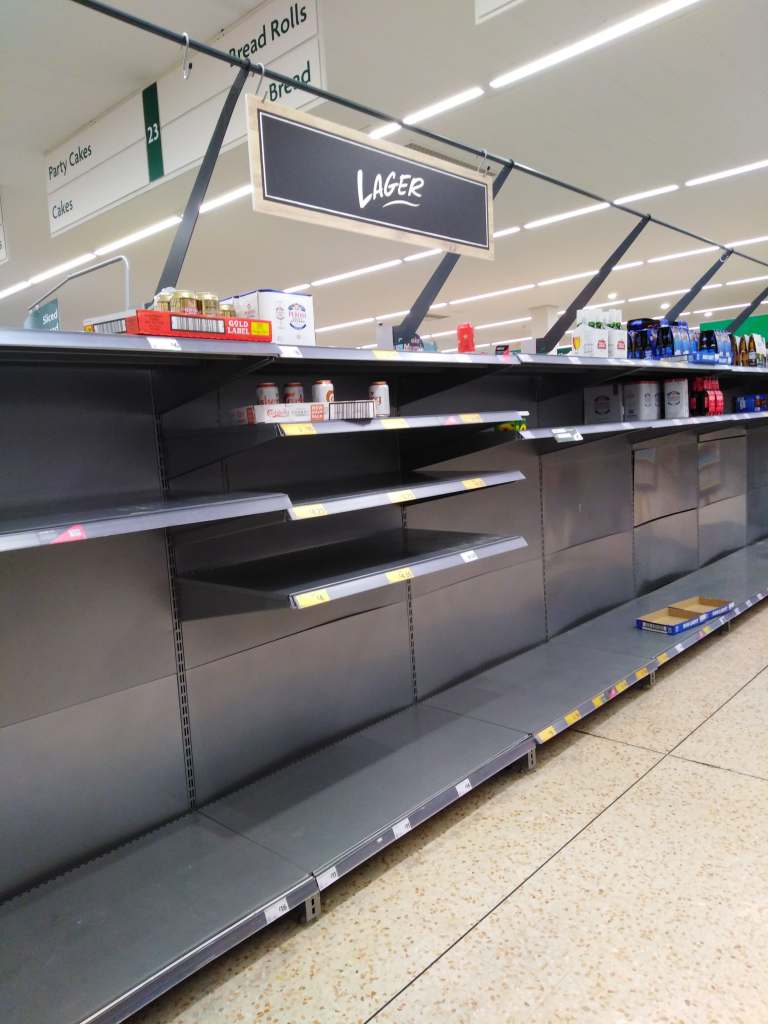
One of the puzzling things about human choices in a time of crisis is the obsession with toilet roll – something which appears in Australia, France, the UK, and seemingly everywhere.  Toilet roll seems for many to act as the adult equivalent of the infant’s comfort toy.  As long as we can exit a supermarket clutching three or four super-sized packs of Andrex, Cottonelle, or Charin we will sleep safely at night, knowing we are now able to face any crisis.  Yet it’s not just toilet paper; alcohol too can offer some of that comfort.  When I was in a supermarket the other day the person in front of me was bulk-buying bottles of rosé wine.  Nor is it just wine – as this picture of the lager aisle in a UK supermarket, courtesy of the blog’s editorial manager, reveals.

Some commentators are suggesting that wine is now a ‘crucial survival tool’.  According to an article posted by W. Blake Gray on Wine-Searcher.com the Californian Wine Institute has stated that wineries are ‘essential’ services in their State so that they should continue working during the state of emergency there.  Meanwhile the same article notes that Sonoma County has specifically allowed wineries to go on making wine (although they can’t sell it); the thing is that (as is happening in many places) regulations are issued very speedily yet without precision or clarity.  As a result the Wine Institute have advised its members that they consider what their members do is essential, so they should carry on making wine.  Meanwhile in the UK the Mail Online has noted that sales of wine ‘soar as tipplers stock up on the essentials in case they have to go into coronavirus self-isolation.  Purchases by ‘panicked customers’ mean that Naked Wines have had to suspend accepting orders temporarily.  Again – it’s an essential.

In a time when chaos and disaster seems to lurk just outside the front door we all need treats to ease our worries.  As the Bible says, ‘wine gladdens the heart of man’ (and maybe women as well), and certainly all of us who drink it know how a glass or two can lift the spirits.  Maybe, though, it goes further than that.  Wine is a magical product, which can transform us; we may try to rationalise that magic now, but for millennia drinkers with no knowledge of fermentation attributed the drink to some kind of deity; so because a god or goddess made it so it can magically change us in turn.  Perhaps in drinking wine (or any kind of alcohol) there remains a subconscious belief that the drink will transform us into an immortal, and keep the disease away.  No one will seriously believe this, of course – but then no one really thinks they need 150 toilet rolls to survive the next few weeks.

At a more personal level, I’m currently very fortunate.  At the time of writing, one of the five very specific reasons for which we are allowed outdoors in France (each of us clutching a sworn statement ‘on our honour’ explaining why we are not at home) is ‘short excursions, close to home, for physical exercise’.  As we live by vineyards, hills, and forests we can get good walks (maybe not so short) to break up the monotony of being indoors.  You occasionally meet a few like-minded people, smile and pass on opposite sides of the path, keeping as much space between you as possible.  Then, when we get home, the cellar has enough wine in it to last us a few years if necessary.  Meanwhile the market in the village is still open (although fairly deserted) as are the supermarkets.  Families with uncomprehending young children are stuck in small flats in towns and cities and single frail elderly people struggle even to get necessities.  It induces a level of guilt.  What to do?  I think this is the time to revisit Camus’ greatest work la Peste, which I haven’t read for 40 years.  After that, maybe, read for the first time Love in the Time of Cholera.  They won’t make the world a better place, but may help us to have more understanding of what others are going through and ensure that how we live can take more account of them. This particular blog theme is likely to be continued…

Tradition and change on Santorini

[Warning – this is quite a long post and may take a bit of your time.  But it’s about an important issue, relevant to social and economic change in many emerging wine regions.]

I had a long and very comprehensive talk with Markos Kafouros, the President of Santo Wines, on Santorini.  Santo are the cooperative on the island, and unlike cooperative wine producers in many parts of the world the wines they make are the equal in general quality of other, private producers; like all the others they make a crisp but full-bodied white wine mainly from the variety assyrtiko – and it has carved out a very distinctive place in the affections of many wine lovers over the last decade or so.  In spite of this, what was interesting me was less the wine and more the social change taking place in Santorini and how it might be affecting the wine industry there.

Mr Kafouros is a grower; he is elected President of the cooperative by a complex process which involves all of the 1,200 members.  He has been in this post for twelve years.  He was also for eight years a local mayor, a fact which is relevant to what follows. 

We sat on the terrace at the cooperative, overlooking the caldera of Santorini.  Around 1,600 BCE Santorini – which was a medium-sized roundish island towards the south of the Aegean – was blown apart by a volcano, leaving a horseshoe-shaped remnant remaining around the crater where the volcano had erupted.  The island itself was covered in a layer of volcanic ash followed by lava.  It is possible that no-one survived, and the devastation inflicted was much wider, reaching at least down to Crete and possibly to Africa.

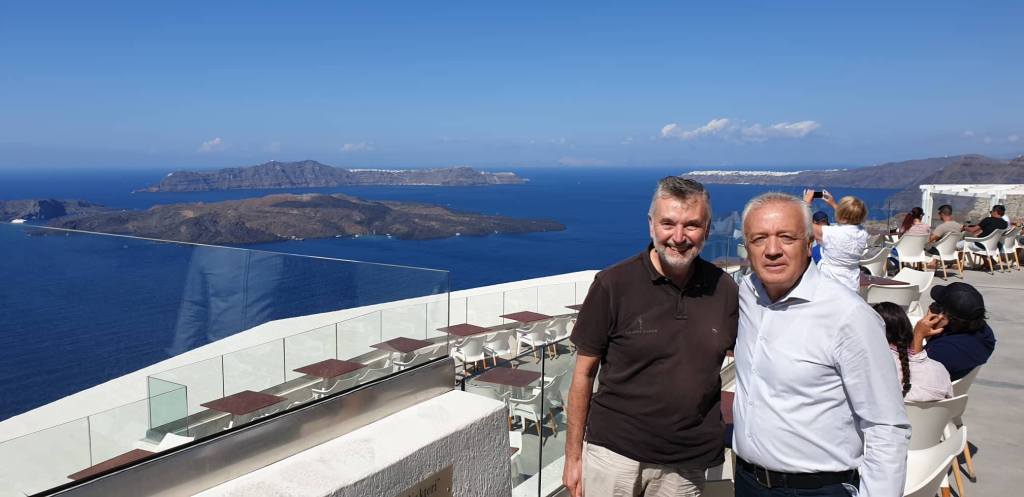
On the terrace of the caldera with Markos Kafouros. The island in the immediate foreground is the result of further eruptions of the volcano over the centuries. Picture courtesy of Stela Kasiola.

Since the 1990s the wine industry has rapidly developed on the back of a great local variety – assyrtiko.  In this period Santorini has also become a prime tourist destination – renowned for the views into the caldera and for its white and blue painted churches.  Santo Wines opened the first cellar door on the island in 1992 and others have followed since then – although wine isn’t the main focus of most visitors.  Nevertheless, for example, another producer, Estate Argyros, has around 30,000 visitors a year. 

As Mr Kafouros recounts, the cooperative exists very much to preserve the unique agricultural traditions of the island.  As well as wine, it has a small production of fava beans (a form of lentil) and tomatoes (turned into tomato paste) – both specialities of the place and protected by PDO legislation, just like the wine.  These are all nurtured out of one of the toughest agricultural environments available; an arid combination of the hardest imaginable rock plus ash under your feet, the sun engulfing you from above and strong winds whipping off the sea from all sides.  The cooperative believes in innovation and careful planning – but all towards the end of preserving what has been the traditional business activity of its 1,200 members.  ‘Innovation’, I’m told, ‘cannot stand on its own; it needs history’.  It also needs a specific environment – the ecosystem that has been created by millennia of volcanic activity.

Into this unique little world has stepped the tourist.  Maybe two million of them a year (while the resident population is under 30,000).  Like a volcanic eruption this has blown apart the human ecosystem of the island.  Hotels are everywhere, as are restaurants, bars, and souvenir shops.  Driving through the narrow streets of Fira, the main town, has become an exercise in total focus to avoid other cars, mules, pedestrians, and quad bikes.  In response to this rapid change the cooperative does not just see itself as protecting the island’s traditional products but also its community.  Nevertheless, it seems to me that such a response avoids dealing with the key issue of the rapidly developing infrastructure and its infringement on the land available for agriculture in the area. 

Markos Kafouros accepts that.  He points out though that there are three levels beyond the wine industry: national and local government, and the local community.  They have attempted to review the impact and potential development of tourism on the island – but national and local governments change, and their agendas and priorities change.  Some legislation has been passed at national level to allow general zoning to protect agricultural land, but it is very broad and perhaps unsuited to dealing with the specific situations which may arise here.  Meanwhile the cooperative is trying to provide incentives to members to stay in agriculture – mainly by paying its members a high price for the grapes they deliver – around 5€ per kilo – making this probably the second most expensive region for grapes in Europe after Champagne.  Furthermore, he says, the growers remain emotionally attached to their land – and they are proud that their grapes, which had no market outside the island a decade ago, are making wines sold in the best restaurants in New York and Melbourne or being praised by the top British and German critics.

I’m still not convinced.  Crucially, why would growers continuing back-breaking work in the heat and wind of the island if they could sell their small plot of vineyard land for a few hundred thousand euros?  Traditionally small-scale agriculturalists in Southern Europe would not sell.  Partly because their land was their security but even more because of a cultural view that they were not owners of the land, but stewards of it.  They had inherited it from their forebears and had to keep it to pass on to their descendants.  Now, however, their children are reluctant to take on strenuous work in the vineyard when they can get easier employment in hotels or gift shops – and many would prefer to get a better job in Athens or beyond if they can.  Even more, tourism has kept the island going through the decade of Greek austerity – indeed, it has become more prosperous while the rest of the country has struggled. 

The wine industry has also grown over this period.  This is not just the rise in grape price but the fact that outsiders have been coming in to start their own wineries; now it is almost as if there is a ‘waiting list’ of companies who want to move in, just waiting for some land to come onto the market so they can buy it.  This has a positive side – it can help to guarantee a good grape price for growers and it brings in more capital.  On the other hand, the incomers may have less understanding of how to make wines from such a bizarre terrain and may be less committed to working mutually with the existing producers. Big companies, especially, in such a limited vineyard area may push the boundaries of where vines should be grown, pursuing quantity over quality.  This wouldn’t be the first emergent wine region where this has happened.  As Markos expresses it succinctly, the Santo philosophy is ‘not to be in all the markets in the world but to be in the best markets.’

So how can you help to protect the wine industry?  One way would be to strengthen the PDO regulations on production.  My host wants to have a rule that all wines must be bottled on the island (traditionally bottling in the region of origin is assumed to protect quality).  He would also like to develop a cru system (selected top-quality vineyard land) to enable the best wines to be identified.  And to improve the island’s reputation for quality he would like to reduce the maximum yield allowed – maybe by up to 25%. 

Another possibility that has been suggested is seeking UNESCO world heritage designation for the island’s unique vineyards – a recognition of an interaction between humans and their environment.  When I was last in Santorini, about six years ago this was being mooted – but I was told at the time that many local growers didn’t want it, as it would limit their rights to sell their dry, dusty, rock-bestrewn land for a small fortune to local developers.  But the proposal was worked-up by the local authority and a file has been lodged with the national government, who have to decide whether or not to promote it.  They are now about 3-4 years into what could take ten years or more.  But there is a Greek saying according to Mr Kafouros that ‘the start is half of the whole’.  If it’s granted this designation will create a series of legal constraints on development in the designated area, and protection of what humanity has carved out of the rock over the last three and a half millennia.  He accepts that there are a few who oppose the idea but suggests that the problem is not with individual growers, but some opinion leaders who manipulate them – mainly people outside the wine industry.  So the process is in motion – it remains to be seen if it will be successful.  Critically, he feels that they will only move forward by discussion and education (the Greek is paideia, which I’m told has dimensions of culture and understanding in it as well).  This will be one of the chief roles of the cooperative.

All in all, a fascinating conversation with a very thoughtful man.  The cooperative is lucky to have such a balanced and engaged person providing a vision for their future.  As well as producing grapes which he sells to the cooperative, he also has some tomatoes and fava beans as well – and is a bee keeper, hoping that maybe in the future there will be a PDO for island honey.  His father is 87, and still works each day in the family vineyards from 8 a.m. to 11 a.m. Thanks to Stela Kasiola who translated our discussion and added a few insights of her own as well.

Wine and the end of life

When my favourite aunt died we held a party to celebrate her life – and we drank wine at it.  Not just wine, in fact, but champagne (although in the mind of most consumers a death is the one time it is inappropriate to drink champagne she had loved it, and it seemed entirely appropriate).  We don’t talk about death and wine so often but there is a long historical link.

The oldest wine press in Europe

I’ve just visited an ancient wine press from the Minoan era at Vathipetro in Crete – said by the Greeks to be the most ancient in the world (although probably only the oldest in Europe, as there is an older one in Armenia https://prehistoricarch.blogspot.com/2011/01/at-6000-years-old-wine-press-is-oldest.html).  This prompted our guide to talk about another Minoan press at Archanes, nearby, which is situated by a cemetery.  Wine was probably used in the funeral rites of the Minoans – hence the need to have it on tap at a burial ground – so to speak.  There is a logic to this.  Wine and the vine were the ancient symbols of the cycle of life and death around the Mediterranean.  Its annual life cycle mirrored that of people, it reflected ideas of fertility and was – after all – a magical drink capable of transforming the way drinkers felt. 

The Minoans believed in an afterlife and were often buried with grave goods.  Some, it seems, have been found with miniature wine presses in their grave.  The representation that the deceased was a wine maker perhaps?  Or a connoisseur?  Or maybe that when moving on to the afterlife they wanted to have the opportunity to go on making their favourite drink as compensation a for having left the world of the living?

Even today, it seems, wine remains key in some Cretan wine rituals.  Often, when people die they are buried but then dug up some years later for a final reburial.  Before this happens, however, their bones are washed in red wine – the most symbolic local liquid which could represent their passing.

Welcome

This website is currently under renovation. Apologies for any inconvenience caused, it should all be up and running within the next week.

Welcome to my website about wine, culture, and society.  My day job is as a Professor of Wine Marketing – but I have a special interest in how we feel and think about, and engage with, wine.  So this site aims to stimulate debate about the relationship of wine to the varying people and cultures who make it and drink it.  You won’t find lots of advice on what to buy here –  but you will find reflections from my travels around the world of wine about how people think and talk about it, along with various musings related to how we view wine and understand its cultural significance.

You will find my latest posts below.  Older ones are archived by year, and then by the country or region involved.  Because I have close links with Burgundy there is a separate tab for this region.

One reason I’m writing this blog is that I’m really keen to get feedback on what I say, so I can develop, revise or even discard my ideas.  So please comment on what I write.  However, I’d just ask that when posting you give your full name; I think we’re all entitled to know online exactly who is making a claim or accepting or disagreeing with an idea.

For those who are really interested in the subject, you’ll find links to other websites, blogs and resources which I find particularly helpful.  Finally, although I said that this is not primarily a site about wine tasting, occasionally I’ll make a post about interesting wines that I have tried.

Steve Charters