A tale of five Tokajs

Tasted 1st and 4th September 2024

A recent trip to Hungary inevitably featured Tokaj, with a number of great wines from many producers.  However, the most historically interesting selection was a series from Grand Tokaj.  Grand Tokaj is the largest wine producer in the region, and is essentially the inheritor of the old Communist ‘Cooperative’ system (it remained owned by the state until recently); however, this history also means that it has a great library of old wines.  

Grand Tokaji 5 puttonyos Tokaji Aszu 2019

Like the 1988 aszu wine below, this is unusually blended from all six approved varieties available in the region – not just the three main ones of furmint, harslevelu and muscat.  Pale gold appearance.  Rather fresh and light for an aszu wine.  Elegant, well balanced; quite intense apricot jam, some citrus and honey though the most complex example of the style on the mid-palate – yet with an evident very attractive floral tone on the finish.  Fine balance.  A wine made by a winery in good form.

Grand Tokaji Museum Collection 5 puttonyos Tokaji Aszu 1988

Amber colour.  A quite lifted, honeyed, dusty nose, with hints of apricot jam and toasty caramel.  Sweet but not luscious (only 133 g/l residual sugar, which is not at all high by contemporary standards).  Neatly textured, and quite savoury on the palate (even some hints of marmite and nuts), and again toast and honey.  Long, a lovely wine which is trying hard but never quite reaches the stars.  This wine was made during the communist era, in the dying days of the old regime (the Iron Curtain came up the following year).  It would have appealed to the masses at the time – but was probably reserved for apparatchiks only.  The wine certainly gives the lie to the idea that all the ancien régime wines were of poor quality – but we could also see it as a harbinger of the better times which were to come soon after.

Grand Tokaji Museum Collection 5 puttonyos Tokaji Aszu 1964

Attractive hazelnut brown colour.  Fairly intense nose; caramel and caramelised sugar, coffee, savoury – like the 1988 some marmite hints – along with classic bitter marmalade and honey.  Well balanced, quite a clear, cleansing bitterness on the finish.  Despite the age it’s still a lovely wine in its own right.  A flash of colour from the height of the drab days of Communist oppression.

Grand Tokaji Museum Collection 5 puttonyos Tokaji Aszu 1956

Less overt on the nose but with a bit of volatile acidity.  Quite meaty, with a little dried soft yellow fruit like Mirabelle.  Very obvious acidity, nice texture but the fruit is dying rather.  Now a sad wine from a sad time.  This was made at the peak of the Hungarian uprising against Soviet domination, and as the Russians and allies were moving in to crush the population.  A wine which wants to forget where it came from.

Grand Tokaji Museum Collection 6 puttonyos Tokaji Aszu 1940

An awful year for Europe but Hungary was sill not officially at war.  Nevertheless, the dictator, Admiral Horthy, was increasingly fawning on Hitler, with a series of anti-Jewish laws (the Jews had been very significant the Tokaji region and in the local wine business).  This wine, maybe, is the last hurrah of an old regime and a place which had previously been comparatively open and tolerant.  Amber-nut brown, not apparently oxidised; savoury like the previous wines but with some lemon-meringue and pasty tones, as well as a little smoky and cedary.  Complex on both nose and palate.  Tastes dryish, very bright with racy but not excessive acidity.  They could really make wines then, before the catastrophe.

The star of Tokaj dimmed during the Communist era – but as this tasting made clear – it was never completely extinguished, allowing it to spring back into life after the Iron Curtain was drawn back.  Grand Tokaj itself has been modernised, and makes some very good wines today.
Midin Sekizli-Tamnath-Haştan

Tasted 12th March 2024

Those of you who are familiar with your Bible will remember that, in the book of Genesis, it is recorded that Noah was the first man to make wine, following his survival in the flood, and the ark which he had built settling down at Mount Ararat.  (Sorry to everyone out there who believes it was the Georgians who got there first.)  

In a corner of southeast Türkiye, a little to the southwest of Ararat, the river Tigris runs.  In the area there are three Christian villages, whose populations speak Aramaic (the language of Jesus in the New Testament of the Christian bible).  One of these villages, Midin, is making its own wine – as it has done for millennia.  In the region there is another mountain, Cudi, and the legend is that after the Ark settled near Ararat, it came down the river Tigris and Noah moored it in the valley below the peak, a bend in the river right on the modern border with Syria.  This is where Noah first made his wine, after he had released all the animals from the boat.  The name of the wine – Tamnath in Aramaic, Haştan in Kurdish and Sekizli in Turkish – means ‘eight’ – and comes from the eight people in the Ark: Noah, his wife, his three sons Shem, Ham and Japheth, and each of their wives.  This place therefore can claim a continuous use of wine ever since it was first found by its discoverer, and the wine is dedicated to him and the other seven members of his family.  

Its produced predominantly from Boğazkere, a fairly widespread grape in this part of Turkiye, whose name means ‘throat scratcher’ or ‘throat burner’ (which says something of its tannic nature).  As one would expect with a name like that, this is a deep-coloured and fairly full-bodied wine with distinctive tannins.  There is some attractive black fruit however, much of it of a dried character – plum shading to prune.  A warm finish.  Not a wine for the faint-hearted, it must have been reviving (perhaps shaking Noah and his family out of lethargy) after the traumas of a flood and time in a huge ark keeping all the animals from fighting each other.  

The recent rejuvenation of wine production in Midin, including the development of commercially successful wines, has been pioneered by Markus Ürek.  His progress into the world of wine is not a typical one.  He has a PhD, has been an academic at Harvard, worked at the US Congress and, by his story, was persuaded to go back to Midin to plant grapes by his wife, who came from the village (‘she got me into this trouble’).  It hasn’t been easy, but he has won the support of the local people by has commitment to the place, so that now there are 23 people employed in different ways contributing to the wines he makes.

Paltrinieri Lambrusco di Sorbara DOCG ‘Leclisse’ 2022

I suspect that most people who read this blog probably haven’t let a drop of Lambrusco pass their lips for years – even decades.  Sickly, rather thin with big bubbles it’s more in the category of alcoholic, fruity cola than anything to do with wine.  I have, in the last decade, tasted some well made and well balanced Lambruscos, but it is hard to get most people to take the wines seriously.  Passing through Modena – the city at the centre of the region – on my way to Ravenna for the start of an Italian holiday I decided to use the opportunity to visit one of the more renowned producers of Lambrusco to find out more about the region and see what the preconditions for quality are.  My wife very generously agreed to this detour – and I even think she quite enjoyed the visit!

This is a medium sized, independent domaine.  It is run by the current generation of the Paltrinieri family, the dynamic Alberto, but he is third generation.  His grandfather, who was a pharmacist, began it as a sideline in the 1920s.  Historically all the wines were made by the ancestral method (having a current resurgence as PetNat).  Like almost all current Lambrusco much of the Paltrinieri production is now tank (charmat) method.  What was most immediately surprising was that with two exceptions (a white and a red) the domaines wines are all pink – of one shade or another. 

The family focus on producing wines mainly with the local sorbara grape, which they consider, because of its good acidity and fragrance, the best local cultivar.  Sorbara is a sterile grape – which means other grapes need to be planted near it to fertilise it a flowering – in this case salamino.  However, my ‘interesting wine’ is made with 100% Sorbara grapes.

All of the wines are good and it’s hard to pick one – but the one I’ve selected, the Leclisse – for its perfect balance, gently aromatic nose with some beautiful red fruit on the attach and excellent length.  The fizz is soft – although it’s charmat method it is given quite a long, cool second fermentation which keeps the bubbles small.  It’s dry, with – at 11% – an unintrusive alcohol.  This for me is almost the archetype of a delicious wine.  Profound, not really, complex – not very, but pure and focused and so easy to drink with gorgeous flavours.  And very neatly priced.

I want to note that the other wines from the domaine can be excellent; for me the Leclisse just shaded them, but the Radice (‘root’) which was my wife’s favourite was also very smart; it’s the ancestral version (therefore rooted in the old ways of making sparkling wine) and is not disgorged, so still with yeast lees.  There is also the excellent Grosso – a DOC wine made by the traditional method.  Nevertheless, for the first time in my life I’ve got to admit that I think a tank method wine is better than its traditional method equivalent.  That – plus the commitment of the family to maintain their heritage, and to prove that even in the most despised regions good wine can be made – makes it an interesting wine for me.

Piekenierskloof Heidedal Cinsault 2022

After the presentation on the South African Old Vine Project we had a walk around tasting of 50 wines with the Old Vine designation.  Although we’d noted that the designation adds particular value to chenin blanc – and I especially like good South African chenin – I decided to focus on the grape which I think should be South Africa’s icon red cultivar – cinsault. I came to love some of these wines on my last visit and continue to believe that it is one of the world’s greatest undervalued grapes – at least when the vines have aged and it is not cropped too high.  Cinsault features as a major contributor to Old Vine reds as its tolerance of arid conditions meant that it was very widely planted historically and some other grape, most noticeably cabernet sauvignon, which was widely adopted in South Africa from the 1980s onwards – suffered badly from viral disease – so did not provide vineyards which lasted  long enough to make the 35 years required for old vine status.

Perhaps because the grape is seen as a lesser one compared with more trendy red cultivars no-one lavished excessive oak on it which was to the advantage of the wines.  One of the attractions of the grape is that on top of a very aromatic fruitiness the best wines have a dimension which is herbal – reminiscent in South Africa of the Cape Floral fynbos bushland.  In some wines this moves over to what the French might call a sauvage aspect, and this takes it beyond just being a pleasant mid-weight fruity wine.

There were four cinsaults, and three at least were delicious.  The one I’ve finally chosen to write about I selected because I love the name, but a call out also to Bellevue for their 1952 Cinsaut (obviously planted 72 years ago!) and Donkiesbaai for their version.

The Piekenierskloof wine comes from vines which were planted in 1972 at 700 metres altitude.  It was fermented at quite a cool temperature to preserve its fruit aspect and aged in 500 litre old foudres – so benefiting from a bit of oxidation for integration but not picking up any new oak flavour.  Very aromatic, sweet red fruit on the nose.  Slightly dusty tannins but not intrusive, and very, very long with some fynbos complexity.  Extremely good.

Klinker Brick Old Ghost Zinfandel 2018

Anyone who knows me will be astonished that I include this wine in my record of ‘interesting wines’.  A rich, sweet-fruited touching 16% abv monster from a warm part of California?  Steve, you’re going gaga in your old age.  However, remember this is about interesting wines – not wines I necessarily like.  Having said that – this does have a certain appeal to me.

What’s interesting about this is that it’s a wine made by a producer in a less trendy region, trying to make wines which fit there, which characterise their place of origin, and which – within those limits – are honest and well-made.  And the story is good.  Why the ‘Old Ghost’?  Because the owner, Steve Felten, went out into the vineyard one foggy morning with his head trained vines barely visible; they peered as apparitions through the mist and it seemed as if a ghostly farmer had been working them.  The label is a pretty good representation of this.  The wine region is Lodi, in the Central Valley of California, the hot, irrigated centre of cheap wine production in the state (although having said that I remember Robert Mondavi saying that Lodi sits directly in line to a break in the hills leading out to San Francisco bay – so it benefits from some the cooling Pacific breezes swirling through the gap).  The point is that here is a producer who acknowledges that what they do best is hot climate, bold, dynamic wines, and within that context wants to make a balanced, representative wine.  They are committed to old vines, and it seems that these zinfandel grapes come from stock which is over 100 years old.  They are, to their credit, also trying to create some momentum for this approach and for regional identity in their part of California – a cooperative commitment which I admire.  They have the standing to do this: the family are fifth generation, having grown grapes since the end of the 19th century. 

So, what of the wine?  It fits expectations.  Quite deep – though not opaque – appearance, which is typical of zinfandel.  Very intense brambly red and black fruit aromas, a touch of dusty oak and a bit herbal.  Very sweet oak on the palate, only moderate tannins but extremely full bodied with a very warm finish but great length and a hint of bitterness.  Powerful and bold are overused wine adjectives – but they are correct for this.

Having said all this, let’s have a disclaimer.  The wine is represented by (amongst others) one of my former students, Jacylyn Stokes, who comes from Lodi and is passionate about developing the reputation of the region including her own family’s business.  You can use this to dismiss what I say as biased if you want.

Karam Touriga Nacional 2019

One of the interesting facets of the world of wine is the choice grape varieties have had to be travellers or homelovers – a mirror of the recent, nonsensical, socio-political ‘somewhere’ versus ‘anywhere’ argument that apparently underpinned brexit in the UK.  The former are happy being in many, exciting parts of the world, the latter are rooted in a specific, secure place.  So it is with grapes.

Semillon and chenin blanc were probably in South Africa before 1700 and in Australia soon after 1800; merlot arrived in Italy probably 200 years ago and in Chile 150 years ago.  These vines come from the west coast of France – so of course they were shipped around the world, but German riesling also travelled far, to Australia and even to eastern Europe and Russia and zinfandel got to California by 1849.  And, of course, cabernet sauvignon and chardonnay now bestride the world like a pair of colossi.  Yet on the other hand, even within Italy the great nebbiolo has remained limited to the north west (essentially Piemonte) and corvina to the area around Verona.

Slowly, of course, this is changing.  Nebbiolo is in the Adelaide Hills, gruner veltliner in New Zealand and albarino near Lodi in California.  I have to say, however, that when I’m exploring a traditional wine producing country, I’m not that interested in what they do with international grapes.  Chardonnay in Hungary, Merlot in Greece and Cabernet in Georgia don’t really do it for me.  So being presented with a touriga nacional from Jezzine in Lebanon was another of those ‘really?’ moments – they have great ‘adopted’ varieties from the 19th century and indigenous ones from way back in the medieval past which are much more interesting and fun.  Touriga, from the Douro Valley in Portugal, and traditionally used to make port, is another of the grapes that has only just begun to venture out of its homeland – and I was surprised to find it wash up in the hills south of Beirut.

It’s a dense purple wine; and a very intense nose with black fruit: blueberry and plum.  The palate has a very aromatic attack, rose petals and almost Turkish delight – also very spicy.  The alcohol is quite high, but the weight of fruit sustains that easily.  It has great length.  Probably not easy to find – it’s not even listed on their website yet.  But when you are next in Jezzine…

Tokaj Classic Szamorodni 2013.

I first came across the Tokaj Classic wines over 10 years ago, and bought some of their 2005 and 2003 aszu wines.  The wines were stunning, and I still have a few left in my cellar.  I’d never met the Hungarian founder of the company before, and when he contacted me in advance of Prowein it seemed like a good chance to find out more, and renew my acquaintance with the wines.  András Bruhács is an interesting man.  He was a cellist for most of his life (mainly playing at the Wiesbaden opera) but he only settled in Germany when he left Hungary in 1968 as a political refugee.  His father had had a small vineyard in the south of the country, and András helped him out.  However, after he fled the country his main focus on wines was as consuming rather than producing it.  After the fall of the Iron Curtain Hungary opened up slowly, but András had rather lost touch with the country’s wines – if I understood correctly dry red Bordeaux was his focus, and he drunk good chateaux.  In 1993 his wife saw a cover of the magazine Newsweek headlining T]tokaj as ‘the uncut diamond of Hungary’; this prompted him to return to his home country and buy a few hectares of vineyard.  He was helped early on by one of the great figures in the post-communist revival of tokaj, István Szepsy.  His first vintage – in 1994 – was only a few hundred bottles but one the first ever Hungarian Gold Medal at the International Wine and Spirits Competition – and successive wines continued to repeat this feat.

I asked András who his favourite composer is.  A difficult question – but he said in the end Mahler.  That makes sense, for the wines I have in my cellar are bold, intense and very complex wines with great length (though not quite the persistence of a Mahler symphony); perhaps as a winemaker he mirrors the composer – although he said he is now looking for elegance rather than intensity in his wines.

His 2013 szamorodni certainly has elegance.  Although not an aszu wine it’s still sweeter than most sauternes, but with beautiful, beautiful acidity providing great balance.  There’s lovely aromatic botrytis, and typical apricot jam and marmalade on the palate.  Great value, as the price of Tokaj’s more prestigious aszu wines is rising more and more.

Interesting Wines – An Update

The return in mid-May of Prowein in Dusseldorf – the largest wine fair in the world – allowed me to taste lots of new wines, and meet some new producers.  As a result I’ll be posting a notes about a number of wines over the next few weeks.  Remember though, that this is about wines which have a back story, not necessarily lovely wines (although some of them are).  For this blog it’s the background that is important, rather than aesthetic quality.

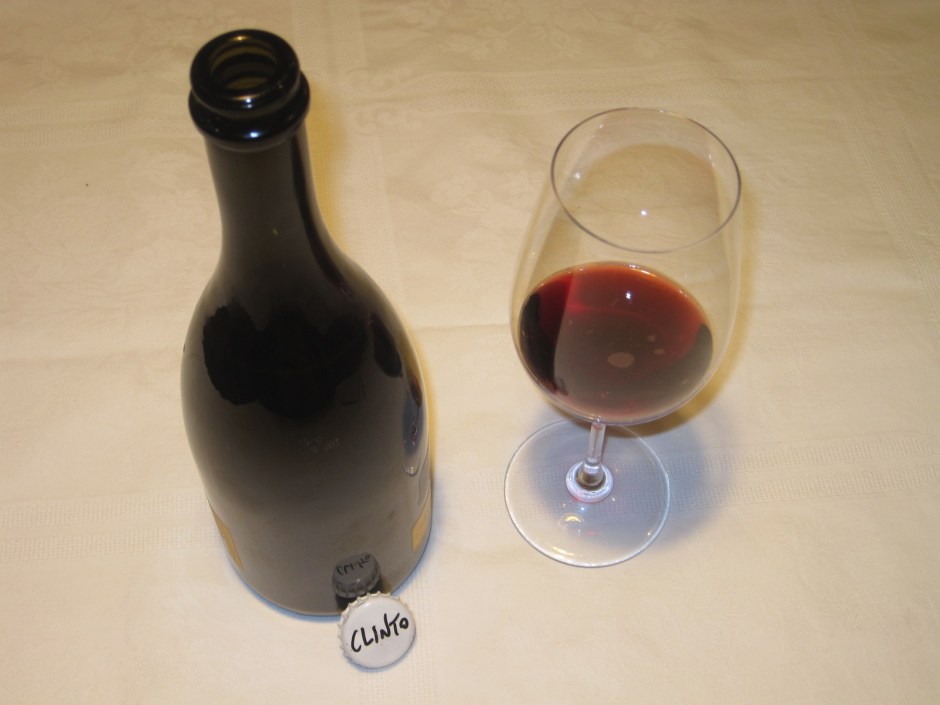
Unbranded Clinton, 2020

The wine was given to me in an old prosecco bottle, stoppered with a crown seal. Pale raspberry colour. A ‘striking’ nose (my partner’s description, attempting not to be too rude.) Strawberry jelly served up in old leathery boots down in a cellar. Spritzy (perhaps malolactic fermentation in the bottle). The tannins are not high but are dusty and unpleasant on the finish without being overwhelming. The acid is unpleasantly high (and I write as one who likes nebbiolo). Strawberry jam fruit, again leather and very bitter; acid also dominates on the finish. A horrible wine. Without question the worst that I have drunk since the beginning of Covid. However, the cultural context of this wine, as a symbol of peasant culture, a counter to the elite (and expensive) local wines, a challenge to the Italian viticultural establishment, and a means of crystallising the work and heritage of past generations, makes it a fascinating marker of rural identity. For more on this see here.